
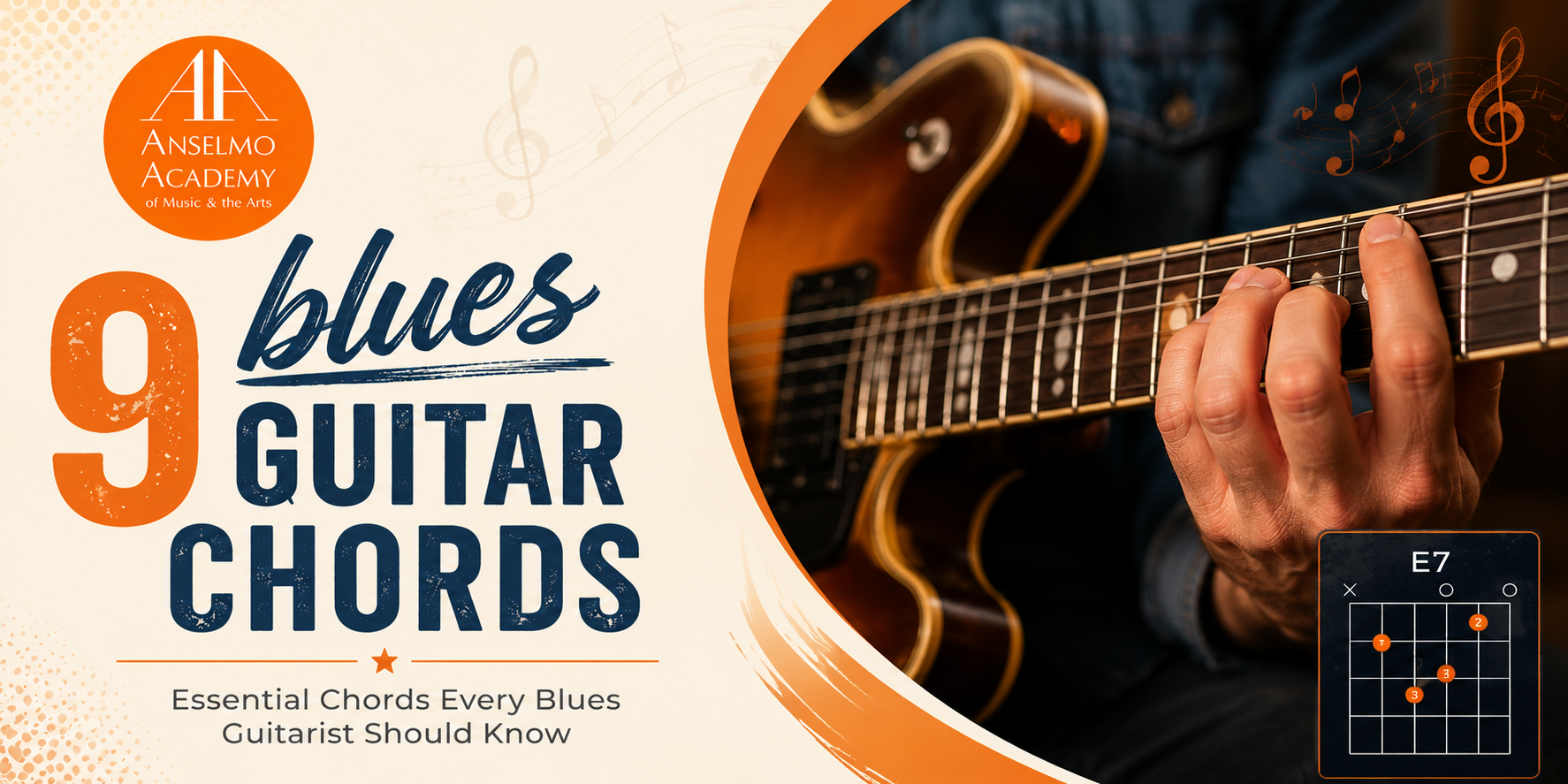
There’s a moment every blues guitarist gets to. You’ve got your scales down, you can hold a rhythm, but something still feels missing. That warmth, that grit, that unmistakable soul. More often than not, what’s missing is 9th chords. They’re the sound you’ve been hearing on old Stevie Ray Vaughan records without quite being able to name it.
This article covers the theory behind blues 9th chords, all 9 blues guitar chords you need to know, how to use them in a 12-bar blues, and common mistakes to avoid.
What Are 9th Chords in Blues Guitar?
A 9th chord is a dominant 7th chord with one extra note, the 9th, which is the same as the 2nd scale degree but played an octave higher. In blues, dominant 9th chords are everywhere. They sit somewhere between gritty and jazzy, which is exactly why they work.
The Theory Behind Blues 9th Chords
Dominant 9th chords are built: Root – Major 3rd – Perfect 5th – Minor 7th – Major 9th. On guitar, you don’t always voice all five notes, the 5th usually gets dropped. What stays is that tension between the minor 7th and major 3rd, and that’s where the blues lives.
Chord #1 – E9
E9 Chord Shape
The classic E9 shape: x7677x – barre the 7th fret, then add fingers on the 8th fret of the A and D strings.
When to Use E9
E9 is your I chord in E blues. It fits slow shuffles and funk grooves equally well.
Practice Exercise for E9
Palm-mute and strum a straight eighth-note rhythm on E9 for 30 seconds, then shift to a swing feel. You’ll immediately hear where the groove lives.
Chord #2 – A9
A9 Chord Shape
Move the same shape to the 5th fret, rooted on the low E string.
Common Blues Applications
A9 is your IV chord in a standard E blues blues chord progression, showing up in everything from Texas shuffles to classic Chicago playing.
Transitioning Between E9 and A9
These shapes are nearly identical, which makes switching between them intuitive. Start slow with a metronome at 60 BPM and build from there.
Chord #3 – B9
B9 Chord Shape
B9 sits at the 7th fret rooted on the A string: x79797.
Role in a 12-Bar Blues
B9 is your V chord in E blues, the tension chord before resolving back to E9. In a standard 12-bar, it hits in bar 9 and really earns its keep.
Practice Tips
Try ending a phrase on B9 and resolving to E9. That resolution is one of the most satisfying sounds in all of blues guitar chords.
Chord #4 – C9
C9 Chord Shape
x32333 in open position, or rooted on A at the 3rd fret using the movable shape.
Blues and Funk Uses
C9 appears in funk-influenced blues and minor progressions. Think Hendrix rhythm work, once you hear it in context, you won’t forget it.
Chord #5 – D9
D9 Chord Shape
Use the movable shape at the 5th fret on the A string for a fuller sound.
Common Progressions
D9 works as the IV chord in an A blues and sits naturally in blues guitar chord sequences moving between D, G, and A.
Chord #6 – G9
G9 Chord Shape
3×3433, root on low E at the 3rd fret using the movable dominant 9th shape.
Blues Rhythm Examples
Try vamping on G9 with light palm muting. It has a late-night feel that’s hard to replicate any other way.
Chord #7 – F9
F9 Chord Shape
1×1211 using a partial barre at the 1st fret.
Movable Chord Applications
F9 is a good entry point into thinking about blues guitar chords as movable shapes. The same fingering at the 3rd fret gives G9, at the 5th gives A9, and suddenly the whole neck opens up.
Chord #8 – E9 (Root on 5th String Variation)
Alternative Voicing
This version of E9 is rooted on the A string at the 7th fret, giving the chord a slightly different tonal character and making it easier to mute the low E cleanly.
Advantages of This Shape
It frees up the low E string and sits better under certain melodic phrases you might be playing simultaneously.
Where It Fits in Blues Progressions
This voicing works well in a blues chord sequence where you want a slightly thinner, more mid-range sound, great for cutting through a band mix.
Chord #9 – Movable Dominant 9th Shape
The Universal 9th Chord Shape
x7677x. Root on the A string, barre on the 7th fret, notes added on the 8th fret of D and G strings. This is the shape everything else has been building toward.
How to Move It Around the Neck
Slide it to the 5th fret, A9. 3rd fret, G9. 10th fret, D9. The root note on the A string tells you the chord name.
Playing 9th Chords in Any Key
Once this shape is under your fingers, you can play 9 blues guitar chords in any key without learning new fingerings. That’s the real unlock.
How to Use 9th Chords in a 12-Bar Blues Progression
A standard 12-bar blues in E uses E9 (I), A9 (IV), and B9 (V). Four bars on E9, two on A9, back to E9, then the classic V-IV-I-V turnaround. Get those three shapes moving cleanly first, then start adding substitutions and variations.
Famous Songs That Use 9th Chords
Stevie Ray Vaughan’s “Pride and Joy,” Jimi Hendrix’s “Fire,” Buddy Guy’s “Damn Right I’ve Got the Blues.” These tracks aren’t just decorated with 9th chords, they’re built on them. Listen back and you’ll start catching the shape everywhere.
Common Mistakes When Playing Blues 9th Chords
Muting is the big one. With so many fingers involved, an open string ringing out is easy to miss. Slow, deliberate practice helps. The other common mistake is rushing changes, in blues, a slightly late but committed change almost always sounds better than a sloppy early one.
Practice Exercises to Master 9th Chords
Run through the 12-bar progression using only the movable 9th shape, changing root notes for each chord. Record yourself and listen back. Also try playing along to a simple backing track and focusing entirely on tone and timing rather than complexity.
Bottom Line
Blues guitar chords, 9th chords especially, are what separate someone who knows blues from someone who feels it. Start with E9, A9, and B9, get the 12-bar running cleanly, then explore the rest. The movable shape alone will take you further than you might expect.
Want to bring these chords to life with real guidance?
At Anselmo Academy, our experienced instructors offer personalized guitar lessons in NYC that musicians and beginners rely on to build real skills.
Whether you’re looking for guitar lessons for beginners or adults or you just want to push your playing further, we’re here to help.
FAQs
What is a 9th chord in blues guitar?
A dominant 9th chord is a dominant 7th chord with an added major 9th. In blues, these chords add warmth and complexity without losing their grit.
Are dominant 9th chords difficult for beginners?
They can feel stretchy at first, but most shapes become manageable quickly with consistent practice. Starting slow with the movable shape is the best approach.
What is the most common blues 9th chord?
E9 is probably the most common, especially in Texas-style blues. A9 and B9 follow closely as the IV and V chords in a standard E blues progression.
How do 9th chords differ from 7th chords?
A dominant 7th has four notes, root, major 3rd, perfect 5th, and minor 7th. A 9th chord adds the major 9th on top, making it richer and slightly more complex.
Can I use 9th chords in a standard 12-bar blues?
Absolutely. Swap your dominant 7th chords for 9th voicings and the progression immediately takes on more colour.
Which blues guitarists use 9th chords frequently?
Stevie Ray Vaughan, Jimi Hendrix, Buddy Guy, Albert Collins, and Freddie King are all known for weaving 9th chords into both rhythm and lead playing.
Are 9th chords used in blues-rock and funk music?
Very much so. Funk especially, artists like James Brown’s guitarists built entire rhythmic vocabularies around dominant 9th shapes.
What are the easiest 9th chord shapes to learn?
The movable dominant 9th shape (x7677x at the 7th fret for E9) is the most practical starting point, playable across the neck and usable in any key.