
If you’ve ever looked at a piece of sheet music and felt a wave of confusion, you’re not alone. Those tiny oval shapes, lines, and curves can seem completely arbitrary at first glance. But here’s the thing: once you understand the logic behind them, it clicks fast.
This guide breaks down everything you need to know about symbols for musical notes, from how a single note is constructed to the more layered stuff like dotted notes and ties.
Learn how to read and interpret the symbols of musical notes on sheet music below.
What Are Musical Notes?
Musical notes are the core units of written music. Each one communicates two things simultaneously: the pitch to play and how long to hold it. That’s a lot of information packed into a small symbol, which is why learning to read music feels so rewarding once it starts to make sense.
It’s also worth saying, this isn’t just for young beginners. Adult music lessons typically start with sheet music fundamentals, and most people are surprised by how quickly the notation becomes easy to read.
Parts of a Musical Note
Every note you see on a staff is made up of specific components. Understanding the parts of a musical note gives you a framework for recognising any note, in any context, without having to memorise each one individually.
- Notehead – The oval shape placed on a line or in a space of the staff. It can be hollow or filled in, and its position tells you the pitch.
- Stem – The thin vertical line attached to the notehead. Direction, up or down, depends on where the note sits on the staff.
- Beam – A thick line connecting multiple notes. You’ll see beams grouping eighth or sixteenth notes together.
- Flag – A curved stroke on the stem of a single note. One flag means an eighth note; two flags mean sixteenth.
- Dots – Placed just to the right of the notehead, a dot increases the note’s duration by half its original value.
These five elements cover pretty much everything. All note symbols are just combinations and variations of these.
Musical Note Names and Their Time Values
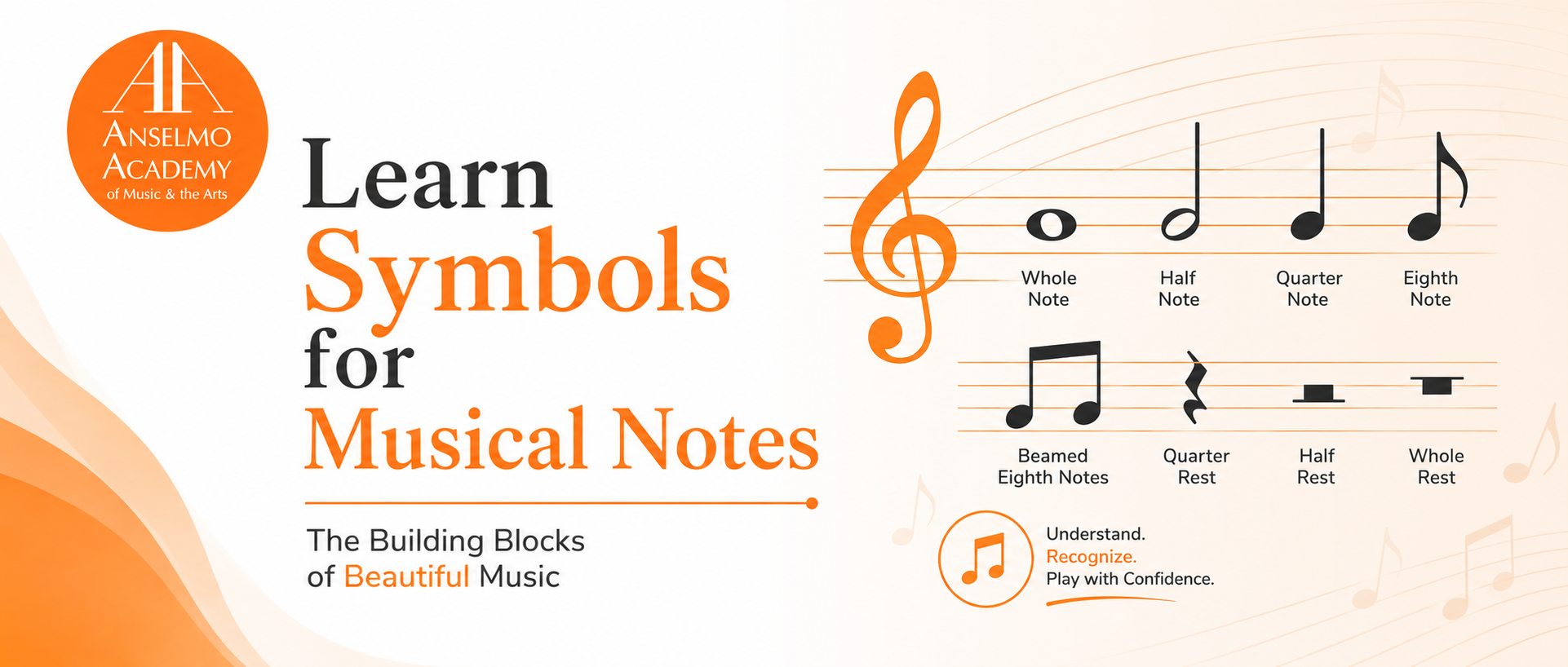
This is where symbols for musical notes start to carry real meaning. Each note type represents a specific duration, and they all relate to each other proportionally.
Whole Note – Four beats. The symbol for a whole note is the simplest of all: a hollow oval with no stem, no flag, nothing attached. Just the open notehead sitting on the staff.
Half Note – Two beats. Looks exactly like the whole note but with a stem. Still hollow.
Quarter Note – One beat. Filled-in notehead with a stem. Probably the most common note you’ll come across in everyday music.
Eighth Note – Half a beat. Filled notehead, a stem, and one flag. When grouped with other eighth notes, the flags become a beam.
Sixteenth Note – A quarter of a beat. Two flags or two beams. Fast passages tend to be filled with these.
Each note is exactly half the value of the one above it. That relationship makes the whole system easy to navigate once you see the pattern.
Music Note Symbols for Dotted Notes and Tied Notes
Dotted and tied notes are where many beginners start second-guessing themselves. The rules are actually pretty clean with one small exception.
Simple Rule to Remember
A dot placed after any notehead adds half of that note’s value to its total duration. That’s it. Half the value, added on.
The Exemption to This Rule
In compound time signatures like 6/8, dotted notes behave a little differently because the beat itself is divided into three rather than two. The math still works, but it can feel counterintuitive until you’ve spent some time with those meters. For now, just know the exception exists.
Dotted Whole Notes
A dotted whole note lasts six beats. In many compound time signatures, this fills an entire measure.
Dotted Half Notes
Three beats. This one comes up constantly in 3/4 time, where a single dotted half note fills the whole bar.
Dotted Quarter Notes
One and a half beats. Very common in both simple and compound time. Once you can feel this rhythmically, a lot of music starts to make more sense.
Dotted Eighth Notes
Three quarters of a beat. These often appear paired with sixteenth notes, creating a lilting, uneven rhythm that shows up frequently in folk and classical music.
Ties and Slurs
These two look almost identical; both are curved lines connecting noteheads, but they mean completely different things. A tie connects two notes of the same pitch, combining their durations into one continuous sound. A slur connects notes of different pitches, indicating they should flow smoothly into one another without separation. Confusing them early on is extremely common. Don’t stress it.
How to Read Musical Notes
Reading music isn’t just about recognising the musical note sign in front of you; it’s about reading it in context. The clef tells you which pitches correspond to which lines and spaces. The time signature tells you how many beats fit in each measure. The key signature tells you which notes are sharp or flat throughout the piece.
Start with the treble clef if you’re playing a higher-pitched instrument, bass clef if lower. Each line and space has a name, and there are memory phrases that help, “Every Good Boy Does Fine” for the lines in treble clef, for example.
At Anselmo Academy of Music and the Arts, students build this foundation early, connecting notation directly to playing so it never feels like abstract theory.
Note Values and Duration
Here’s the simplest way to think about it: in 4/4 time, one whole note fills the entire measure. Two half notes do the same. So do four quarter notes, eight eighth notes, or sixteen sixteenth notes. They’re all different ways of dividing the same amount of time.
The symbols for musical notes are designed to show this visually. Open noteheads are longer. Filled noteheads are shorter. Flags cut the value in half. Dots add half back. The system is internally consistent, which is exactly why online music lessons for kids spend so much time here early, get this down, and rhythm, sight-reading, and timing all follow naturally.
Bottom Line
The symbols for musical notes aren’t as intimidating as they look. Start with the parts of a musical note, learn the basic values from whole down to sixteenth, then fold in dotted notes and ties. The symbol for a whole note is your anchor; it is the longest, simplest note from which everything else is proportionally derived. Build from there, and the rest of the notation system starts to feel logical rather than overwhelming.
Want to Learn About Musical Notes?
At Anselmo Academy, we offer music lessons that lay the foundation of understanding musical notes and symbols. Whether you’re looking for a music program for your young child or an adult seeking music lessons, join us to become adept at reading sheet music.
FAQs
How do I read notes on the treble and bass clefs?
Each line and space on the staff corresponds to a specific note name. Treble clef covers higher pitches; bass clef covers lower ones. Simple memory phrases help with the lines until they become automatic.
What is the difference between a note and a rest?
A note tells you to play a pitch for a set duration. A rest tells you to stay silent for the same duration. Every note value has a matching rest symbol.
How many beats is a whole note?
Four beats, in standard 4/4 time.
What is a half note?
A half note lasts two beats. It looks like an open notehead with a stem, essentially the symbol for whole note with a stem added.
How many beats for a half note?
Two beats in most common time signatures.
How do accidentals affect the pitch of a note?
Accidentals modify pitch by a half step. A sharp raises the pitch, a flat lowers it, and a natural cancels any previous sharp or flat that was applied.